
The Prediction vs. The Reality
If you feel like you’ve been on a financial rollercoaster over the last couple of years, you aren’t imagining things. Back in early 2021, we were all spoiled by historical 3% mortgage rates, only to watch rates aggressively spike into the sevens shortly after. Earlier this year, it finally felt like relief had arrived when rates dipped just below 6%. That sub-6% mark is magical because it is the exact sweet spot where buyers jump back off the sidelines and locked-in sellers finally feel comfortable putting their homes on the market.
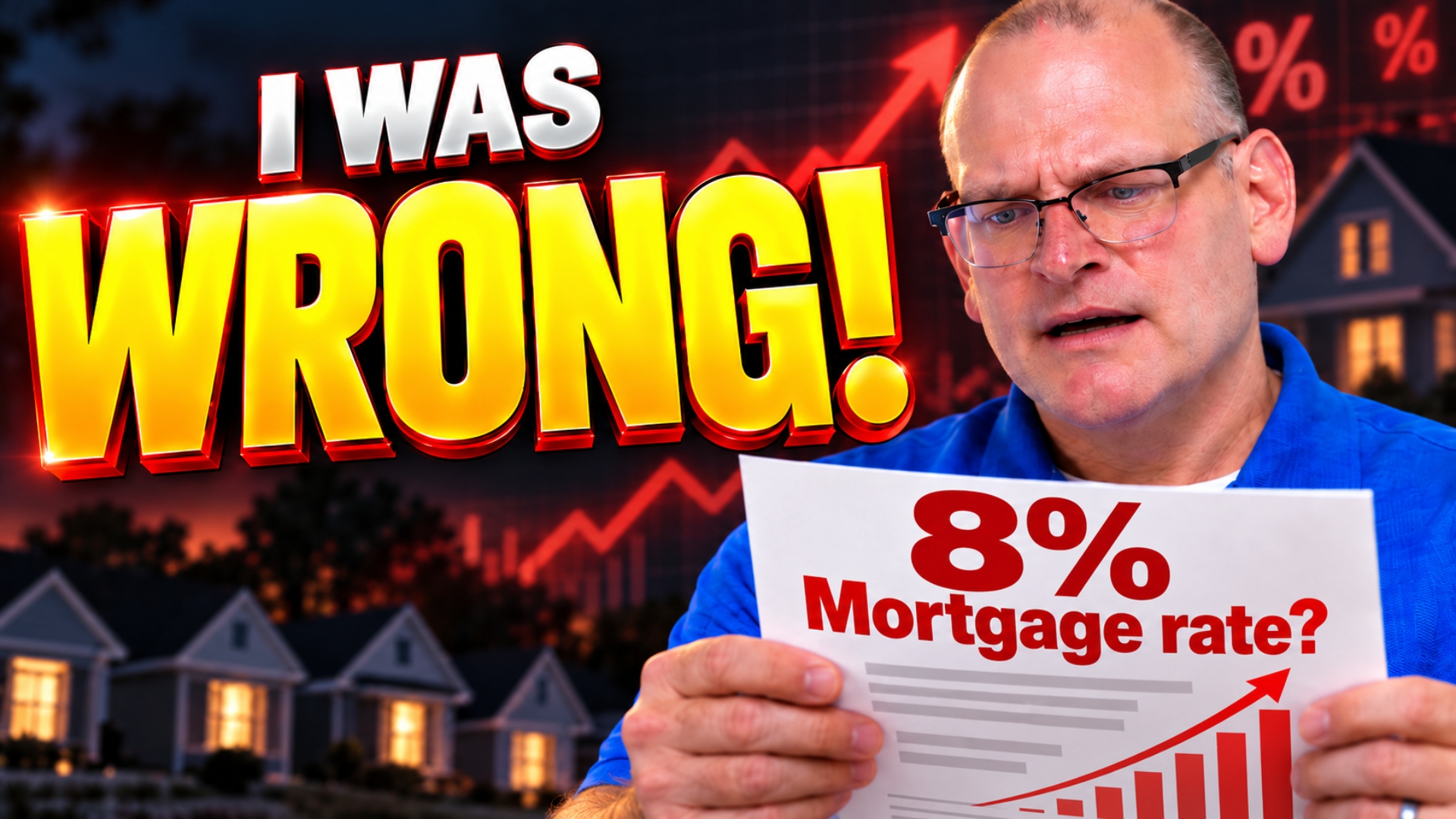
Fast forward to today, and the narrative has flipped. Average 30-year fixed rates have shot past 7.22%, with many lenders quoting closer to 7.5%. What once looked like a smooth journey back to the 5% range has suddenly turned into a realistic conversation about seeing 8% mortgages in the near future.
Inflation, Energy Prices, and Global Domino Effects
So, why are interest rates climbing again? In a word: inflation. Inflation is the single biggest driver of mortgage rates, and global events play a massive role in keeping it elevated.
When geopolitical conflicts disrupt critical shipping routes like the Strait of Hormuz, energy prices react instantly. Oil flows directly into the cost of almost everything we touch—from gas at the pump to shipping, manufacturing, and everyday groceries. When energy prices climb, inflation expectations rise right along with them, creating a domino effect that forces borrowing costs higher across the board.
The Fed vs. The 10-Year Treasury Yield
There is a huge misconception that when the Federal Reserve raises or cuts its benchmark interest rate, mortgage rates automatically move in the exact same direction. That is actually not how it works!
The Fed funds rate is a short-term rate that banks charge each other for overnight loans. Your mortgage, on the other hand, is a 30-year commitment. Mortgage rates don’t follow the Fed—they follow the 10-year Treasury yield.
When you get a mortgage, your lender packages it into a mortgage-backed security (MBS) and sells it to global investors. Because most homeowners refinance or move within 7 to 10 years, investors compare mortgage bonds directly to 10-year U.S. Treasury bonds. Since mortgages carry slightly more risk than ultra-safe government Treasuries, investors demand a little extra return—known as “the spread.”
Historically, mortgage rates sit about 1.5 to 2 percentage points above the 10-year Treasury yield:
-
January 2021: The 10-year yield was at 1.1%, yielding historic 2.65% mortgage rates.
-
Early 2026 Relief: The 10-year yield dropped to 3.97%, pulling mortgage rates under 6%.
-
Current Market: The 10-year yield spiked over 5%, pushing mortgage rates into the 7.22%–7.5% territory.
If the 10-year Treasury yield stays above 5%, 7% mortgage rates are here to stay. If it pushes toward 5.5%, seeing 8% mortgages isn’t just a possibility—it becomes the baseline.
Crunching the Numbers: What 8% Rates Mean for Your Monthly Payment
To understand how this impacts your wallet in Los Angeles housing, let’s look at full PITI payments (Principal, Interest, Property Taxes, and Homeowners Insurance) for two typical local scenarios.
Scenario A: The $1,400,000 Home (e.g., Porter Ranch)
Assuming a 20% down payment ($280,000) and a loan amount of $1,120,000, with estimated property taxes of $1,458/month and $400/month for insurance:
-
5.99% Interest Rate: $8,566 / month
-
7.22% Interest Rate: $9,476 / month
-
7.50% Interest Rate: $9,690 / month
-
8.00% Interest Rate: $10,076 / month
That is a $910 per month difference compared to just a few months ago, and over $1,500 more per month if rates hit 8%—translating to an extra $18,000 a year out of pocket.
Scenario B: The $950,000 Home (First-Time or Move-Up Buyer in LA)
Assuming 20% down ($190,000), a loan amount of $760,000, taxes at $990/month, and insurance at $400/month:
-
5.99% Interest Rate: $5,941 / month
-
7.22% Interest Rate: $6,559 / month
-
7.50% Interest Rate: $6,704 / month
-
8.00% Interest Rate: $6,966 / month
Here, an 8% rate adds over $1,000 per month to the mortgage payment compared to earlier spring rates.
The Shocking Loss of Homebuyer Purchasing Power
Most buyers shop by monthly payment, not sales price. When interest rates rise, your budget doesn’t magically grow to match—your purchasing power simply shrinks.
If your household budget allows for the payment on a $1.4 million home at today’s 7.22% rate, that exact same monthly budget only buys you about $1,313,000 if rates reach 8%. That is nearly an $87,000 loss in buying power from a single point shift.
Compared to the sub-6% rates seen earlier this year, buyers have lost nearly $140,000 in purchasing power for the same monthly check leaving their bank account.
Where the Real Opportunities Lie in Today’s Market
It sounds daunting, but every market shift creates a unique advantage for savvy buyers. As interest rates climb, homes stay on the market longer, causing days on market (DOM) to rise. When properties sit, sellers generally split into three groups:
-
The Stubborn Waiters: They refuse to budge on price and will let the house sit for 8 months hoping for a miracle.
-
The Unlisters: They give up, take the home off the market, and rent it out until conditions change.
-
The Motivated Sellers: This is where you win. These are sellers who need to move due to job relocations, carrying two mortgages, downsizing, or settling family estates.
If you are a patient buyer focused on long-term home appreciation rather than trying to time the exact bottom of interest rates, this third group represents a massive opportunity to negotiate price cuts and terms that were impossible during the bidding war era.
Smart Buying Strategies: Rate Buy-Downs and Builder Incentives
Instead of simply asking for a lower price, creative structuring can slash your actual monthly out-of-pocket costs:
-
Seller-Paid Rate Buy-Downs: You can ask the seller for closing credits specifically allocated to buy down your interest rate (e.g., a 2-1 buydown). This often costs the seller less than a massive price drop while giving you a significantly lower monthly payment for the first few years.
-
New Construction Incentives: Southern California home builders are holding inventory they need to move. Many builder lending arms are offering substantial incentives—sometimes tens or hundreds of thousands of dollars—that can be used to buy down your rate permanently or pay off solar installations.
Focusing on what you can control—getting fully pre-approved, locking in favorable rate terms, and targeting sitting inventory—allows you to make confident real estate moves no matter what interest rates do next.